


Margins
Rupturing Object White was made, and continues to be made, in the margins; these are the very conditions through which the work has been shaped, encountered, and understood. The project developed under precarious circumstances, making use of a daylight photography studio at the University of Gloucestershire whenever booking was possible.
Following a difficult supervisory relationship that deteriorated significantly, I was subjected to surveillance and subsequently uninvited from exhibiting work at the onsite gallery. Yet I have remained committed to the belief that work can exist within the cracks of the ivory tower: that it can inhabit institutional margins while simultaneously critiquing the structures that produce those margins, and, in doing so, generate innovative forms of existence and resistance.
Alongside this, I have increasingly made work outside of institutional walls, using exterior and non-sanctioned spaces as sites of production, thought, meaning-making and relating otherwise. I would strongly encourage students and artists to recognise this as a viable and necessary strategy when the institution in which they study or work becomes epistemically violent, extractive, or creatively restrictive. To work outside is not simply to relocate practice physically, but to refuse the terms under which knowledge, legitimacy, and artistic value are too often assigned within academic structures. In this sense, the outside becomes not a deficit of resources, but a generative condition from which other visual, critical, and political possibilities can emerge.
I alchemise these bad experiences. I think it’s a way of realising possibility beyond evil/what another has set out for you. And I suppose its a powerful rejection of oppression.
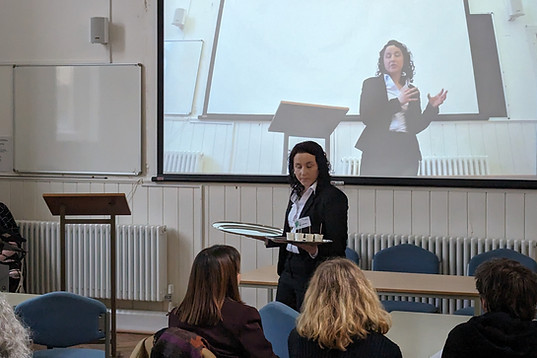
In-between spaces // Creative Arts Conference Gloucestershire University
In the cracks of an institution, you sometimes find the people who make it possible to stay — where hope exists beyond narcissism and capitalist permeation. These are the spaces where like-minded people gather, where respite becomes possible, where collective breathing is invited…
For three years in a row, this conference has been a beautiful queer space. The way bell hooks describes it in her 2014 New School talk: “queer, not as being about who you're having sex with—that can be a dimension of it—but queer as being about the self that is at odds with everything around it and has to invent and create and find a place to speak and to thrive and to live” (hooks, 2014). It has been an accepting, inclusive environment where I can show live artwork without having to justify its form, its temporality, or its unruly methods. Under the care and leadership of Duncan, Carlie, Tom and James, the conference has offered me a rare breathing space: a place where practice‑as‑research is not only understood but actively embraced.
Within these fractures, people remember how to look sideways instead of upward. Conversation loosens from transactional shortcuts. Time briefly escapes extraction. The body unclenches enough to notice itself among other bodies. And in that noticing, another social possibility flickers: mutual recognition. Something that doesn't concern itself with optimisation or competition, or any other rudimentary segregational devices. Even if it is brief, a fleeting unison of differing pluralities, it is still a shared room that has escaped the operations of the rest of the university. There is such beauty in this space that occurs once a year.
Our approach sits within a lineage shaped by Brad Haseman, Robin Nelson, Estelle Barrett and Barbara Bolt, where knowledge is able to be expressed beyond language, generated through doing, sensing, and relation. It is a methodology that foregrounds co‑production and dissolves hierarchical structures of knower/recipient or creator/consumer. Instead, knowledge emerges in the encounter — in the shared, contingent space where bodies, materials, people meet.
I would like to thank the Creative Conference team, for providing me anchor points throughout my time at Gloucestershire University.
References:
Barrett, E. and Bolt, B. (eds.) (2007) Practice as Research: Approaches to Creative Arts Enquiry. London: I.B. Tauris.
Bolt, B. (2004) Art Beyond Representation: The Performative Power of the Image. London: I.B. Tauris.
Haseman, B. (2006) ‘A manifesto for performative research’, Media International Australia Incorporating Culture and Policy, 118(1), pp. 98–106.
Nelson, R. (2013) Practice as Research in the Arts: Principles, Protocols, Pedagogies, Resistances. Basingstoke: Palgrave Macmillan.
Outdoor and in-between spaces
Meeting point atemporally from social/outside, personal, cultural and political spheres ...
As interior university working spaces became increasingly difficult to sustain under conditions of restricted autonomy, repeated interruption, and documented institutional friction, exterior locations emerged as necessary continuations of the studio rather than secondary alternatives. For this reason, working outside was never simply an aesthetic preference, but a practical and methodological response to environments in which sustained artistic production had become conditional. When sanctioned spaces become too tightly managed, too visible, or too difficult to occupy, the conscious student or artist must begin to seek other sites where work can continue beyond institutional epistemic violence. Whiteness requires bodies to maintain it, and complicity to preserve its order; for this reason, other spaces become necessary not only to breathe differently, but to encounter forms of kinship, resistance, and like-minded making beyond the hostility within the university or gallery.
Removed from the managed visibility of these interiors, outdoor space offered a different register of time, movement, and decision-making—one less governed by surveillance, spatial competition, or equipment and space that is conditional. Within these exterior settings, the work developed a heightened responsiveness to weather, ambient sound, passing light, uneven surfaces, people and contingency, allowing material uncertainty to become an active part of the live ecology. The movement outdoors therefore marked both a continuation of practice and a critical shift away from inherited institutional expectations, demonstrating how displaced conditions of making can generate their own visual and political language.

Rabid Heart (Feb - June 2025)
This work was produced through pre-booked, intermittent use of a daylight studio at the University of Gloucestershire, a transient and continually shifting space that rarely remained stable from one booking to the next. Although the space was booked in advance, changes to the studio layout, equipment, and surrounding materials frequently required the work to be reconfigured, and rethought in response to altered conditions. The presence of staff members using the space to install and present their own work further contributed to this instability -- in the single booked space -- producing a layered environment in which multiple practices coexisted within the same spatial and temporal frame, contesting time and decisions. On one occasion, a staff member entered without warning while I was undressed, prompting me to grab my bathrobe and sit down quickly, attempting to shield my body rather than allow myself to be exposed without consent. This incident forced me to develop practical strategies — such as the use of privacy screens — to protect my autonomy within a space that was nominally booked yet never fully secure. After explaining that the work incorporates sound and that uninterrupted bookings were necessary for documentation, that same staff member entered again the following Saturday and repeatedly struck the studio door with a vacuum cleaner. The abrupt, intrusive noise — a kind of institutional rupture — pushed me toward thinking with noise‑core practices, particularly their capacity to interrupt, and refuse normative expectations of order, and compliance. This opened a new line of enquiry: how the violent, uninvited sonic presence of the institution might be reworked as a decolonial element within the piece, exposing and 'inverting' the power dynamics embedded in who is allowed to make noise, who must remain quiet, and whose presence is treated as interruptible.
On an occasion that spanned a couple of weeks, the booked space was repeatedly disrupted by the sudden appearance of archived fine art paintings, bags of rubbish, loose nails and screws, an abandoned post‑office sack, and additional tables and chairs. This happened immediately after I had emailed several staff members outlining my intentions for the space in the upcoming weeks — staff I had assumed were decent, supportive people. Funnily enough, the staff member I had booked the space with was the same person who later filled it along with other colleagues, making visible the institution’s uneven distribution of space and priority.
The contrast was stark: other rooms — carpeted, with fewer open plug sockets, and entirely empty — remained unused. At that point, it was clear the obstruction was retaliatory, a response to my insistence on autonomy, particularly as the room I had identified as empty was left open with its lights on. Because of the nature of my work, I could not use the carpeted room, some rooms of which were large and closer to where the vans would eventually park to collect the paintings.
As a white student and as someone who is neurodivergent, I was naive and ill‑prepared for the ruthlessness of what unfolded. I genuinely believed there was good faith in people, but institutions operate through insidious mechanisms that collectively remove anything perceived as a ‘threat’ to the operation at hand — an operation that is not inclusive and peformative/ the appearance or theory of decoloniality without actually practicing it. What I encountered was not the action of one individual but a coordinated, systemic response, a form of institutional self‑protection that relies on complicity. It is this collective effort — the willingness to preserve the status quo — that sustains institutional whiteness.
Under these precarious conditions, I learned to make quick, unapologetic decisions. The work evolved through a heightened responsiveness to circumstance, where time and space became deeply interconnected and contingent. Rather than treating these interruptions solely as obstacles, I began incorporating elements of the surrounding archive into the visual field, allowing the work to register not only its formal concerns but also the material pressures of its production. Across four iterations of Rabid Heart, each installation generated a distinct visual and affective outcome, demonstrating how a single work can accrue multiple lives through contingency, adaptation, and institutional friction.
These conditions shaped both the material and methodological development of the work, where installation, interruption, and response became part of the process rather than external factors. They also shaped my relationship to the institution itself. When the same staff member who vacuumed on a Saturday and walked into the booked space unannounced numerous times appeared again, I tried to see every possible positive. But when he shouted "cunt" and slammed the door that shared the same wall as the studio, I decided to return to working outside and at conferences, where I made the work live. Hardwick had closed shortly afterwards, and I no longer wanted to expose myself to further hostility at Park Campus. Refusing the directives of supervisors who maintained colonial aesthetics when your project is attempting to challenge them came with relentless collective harassment and epistemic violence.
